Decision Capital: The Compounding Advantage Behind Industrial AI

 Copied



How Seeq captures expert judgment, connects operational context, and helps organizations make better decisions faster
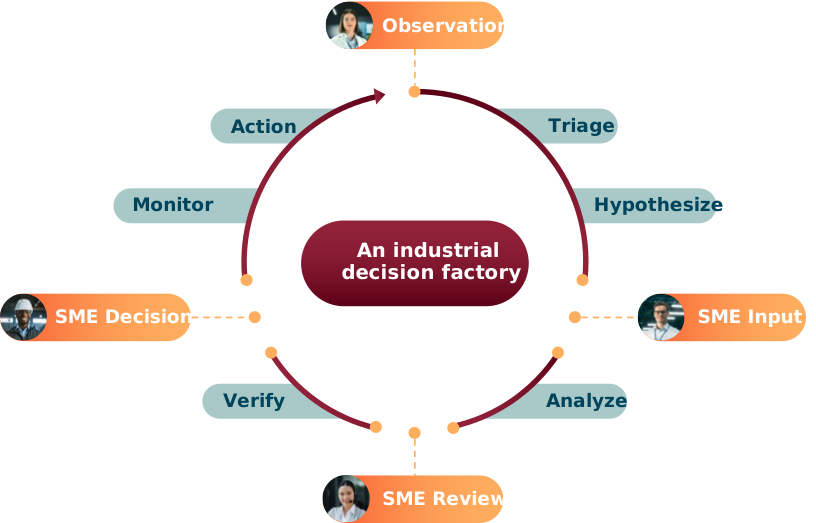
The Industrial Decision Factory
Agentic AI arguably found its first durable foothold in software engineering. A variety of AI tools are being used every day by engineering organizations. Human experts define what should be built and why, review whether the result is correct and acceptable, and rely on agents to produce it. Much of the iteration between those points is now the domain of agents. It is a modern reinterpretation of the Software Factory.
Industrial operations impose far more complex conditions. Industrial engineers, plant managers, and operations analysts work in environments where processes vary with feedstock, equipment state, and ambient conditions. Safety requirements and regulations narrow possible actions. Data arrives incomplete, noisy, or delayed, while important context exists only in human memory.
The challenge is not simply generating more analytics. The context required for an industrial decision is spread across dozens of systems and held in human memory, with no equivalent of the code-commit history in software that would explain why a past call was made.
Consider a compressor with a vibration signature that could indicate bearing wear. The analytics may be straightforward. The decision is not. The team must weigh maintenance history, production commitments, safety limits, planned turnaround timing, and prior experience. An internal analysis of four real oil and gas machinery decision workflows found that teams referenced 77 distinct non-time-series information sources and involved 21 personas. None of the decisions relied on time-series analytics alone.
These findings make the gap clear: industrial decisions require a system that brings together disparate data, operational context, and expert judgment. That system is an industrial decision factory. Creating one requires three elements:
- A robust framework for complex operational data
- Expert-driven context that explains what the data means
- Adaptable tools that can analyze new situations and support action
The Emergent Knowledge Graph
Seeq’s framework arose from its approach to the uniquely difficult nature of time-series data and making it usable at scale across operations. The streaming calculation engine creates conditions from raw signal data and composes new datasets on demand, so agents are not confined to existing analyses.
Framework and tools still leave the hardest of the three: context. Since Seeq was founded in 2013, the platform has been built with a graph under the hood. Instead of requiring customers to first define an ontology and populate it with data from systems of record, the platform assembles context from metadata, connected sources, and the data and work products of experts.
This is Seeq’s emergent knowledge graph: a living layer of relationships among operational data, assets, analyses, models, documents, events, and expert work. An emergent graph does not require the enterprise to hold still while it is being modeled. It reflects work that happened, how, and why. Context becomes reusable across operational workflows.
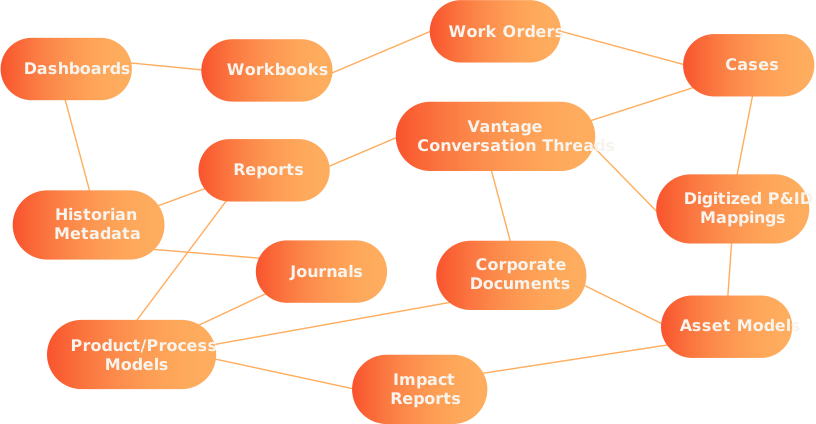
The graph makes relevant context available for a decision. For a maintenance workflow, that context might include the asset hierarchy, current operating conditions, prior failure patterns, approved models, maintenance history, and previous decisions. When this connected context is used to investigate problems, validate methods, guide actions, and capture outcomes, it becomes more than a graph. It becomes a durable record of how the organization makes decisions.
The Asset That Compounds with Use
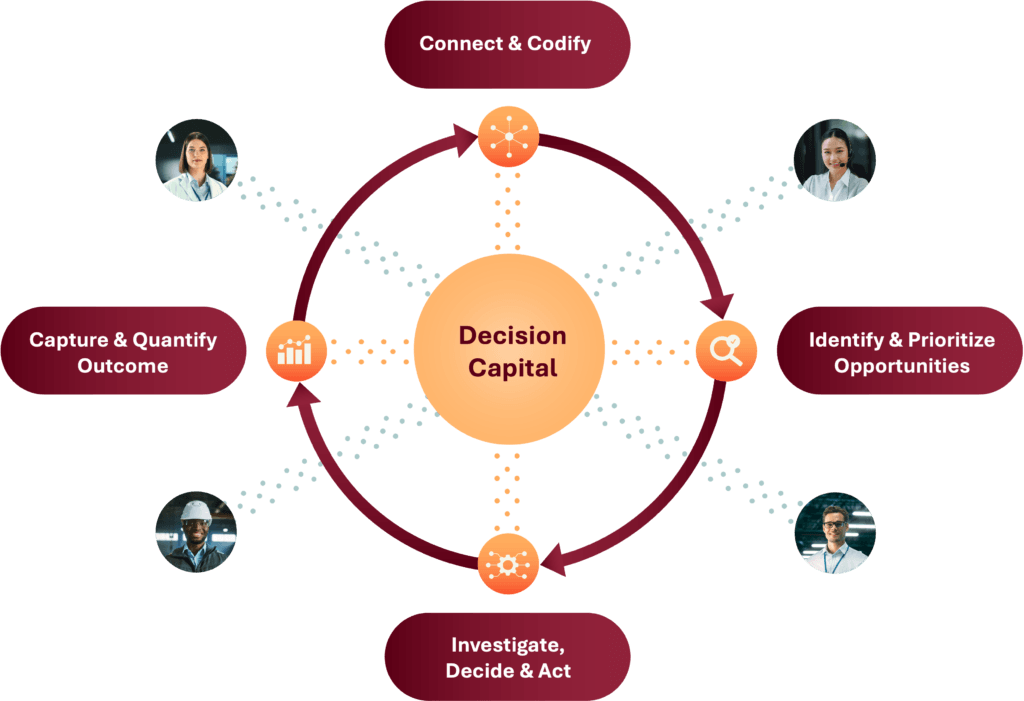
Decision Capital is the accumulated institutional intelligence behind better operational decisions: trusted data, verified analytics, operating context, expert judgment, decision rationale, actions taken, and outcomes achieved. Each validated analysis, governed model, documented investigation, and measured result can make the next decision faster, more consistent, and more traceable.
Seeq captures and creates this asset as a natural by-product of experts doing their work, not as a separate documentation exercise. Seeq AI helps synthesize evidence, recognize relevant patterns, and surface recommendations grounded in an organization’s assets, operations, and decision history. Recommendations should be reviewable by experts, traceable to supporting data and analysis, and subject to human confirmation before action.
What makes industrial AI valuable is not a chat interface over a commodity model. It’s grounding decisions in an organization’s own assets, context, and expertise. Industrial advantage will come from making an organization’s best judgment reusable at scale. That is the compounding value of Decision Capital.